Review Hub
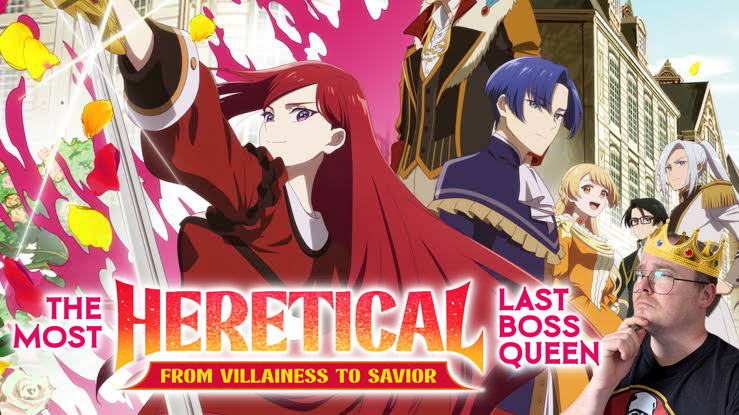
The Most Heretical Last Boss Queen: From Villainess to Saviour poster

Image credit: © Tenichi / Ichijinsha / The Most Heretical Last Boss Queen Production Committee 2023. Used for purposes of criticism and review.

Anime

The Most Heretical Last Boss Queen: From Villainess to Saviour

Podcast ReviewBy KRISPublished 7 September 2026
4/10NCN Score

The setup

What happens when you wake up one day and realise you're living inside a video game — except you're not the hero? You're the villainess destined to become one of the most hated characters in the entire story.

That's the premise behind *The Most Heretical Last Boss Queen: From Villainess to Saviour*, which follows Pride Royal Ivy, a young princess with a particularly unfortunate destiny.

Pride Royal Ivy was destined to become a monstrous princess and, eventually, an evil queen. However, everything changes when she collapses at the age of eight and suddenly remembers a previous life.

Rather than simply remembering her childhood, Pride realises that she is actually a Japanese college student who has been reincarnated into the body of the villainess from a popular video game.

And she knows exactly how the story is supposed to play out.

The original Pride is destined for a horrific fate, but this new version of the character has the opportunity to change everything. Rather than becoming the evil queen everyone expects, she decides to use her knowledge of the game's story to change the future and become a saviour instead.

One of the more interesting aspects of the first few episodes is seeing the differences between the original game's storyline and the decisions this new Pride makes.

For example, in the original story, Pride orders her younger brother Stale to kill his own mother. Naturally, the new Pride isn't exactly keen on repeating that particular decision.

Positives

Visually, the series looks pretty good. The animation is clear and the voice acting is also solid, with Ai Fairouz providing the voice of Pride.

One thing that surprised me is just how quickly Pride accepts her new situation. There isn't a huge amount of time spent on her freaking out about suddenly becoming a character from a video game. Instead, she seems to very quickly get on with the job of trying to fix the story. The series also makes good use of Pride's knowledge of the original game. We regularly see flashes of the decisions the original Pride made and how the new Pride changes them.

It's essentially watching someone replay a game for a second time — except this time they're actively trying to avoid all the terrible choices they made during their first playthrough.

Negatives

There is A LOT of internal monologue.

Pride spends a considerable amount of time explaining her thoughts, the world around her and what she remembers from the original game. This is useful for establishing the lore, but it does mean the series can feel quite exposition heavy at times.

And then there's Stale.

Yes, Stale.

I don't know why, but I found myself wondering throughout the first episode why is the younger brother called Stale?

It sounds less like the name of a prince and more like what happens when you leave bread out for too long.

In terms of abilities, Stale has the power of teleportation, while Pride possesses the ability of foresight. Other abilities, such as eternal youth, are also mentioned, although the first episode doesn't go into too much detail about them.

4/10NCN Score

Verdict

At Anime Club, we watch the first three episodes of an anime and decide whether we'd carry on and complete the series.

Personally, I don't think this one is for me.

That's not necessarily because I think it's bad. In fact, there's quite a lot here that works. The animation is good, the voice acting is solid and the central idea of changing the fate of a villainess is genuinely interesting.

The problem is that I'm just not particularly interested in the direction the series seems to be heading.

There isn't a huge amount of action, with the story instead focusing heavily on lore, character relationships and political drama.

It feels like we're heading towards a series where the big conflicts are going to involve political manoeuvring and difficult decisions rather than someone simply punching another person through a wall.

The whole thing feels a little bit like watching someone play a Victorian style dating sim for the second time, except they're desperately trying to achieve the good ending after already seeing what happens when they make all the wrong choices.

There is definitely an audience for this sort of story, and if you enjoy villainess isekai, political intrigue and stories about changing predetermined futures, The Most Heretical Last Boss Queen could be worth checking out.

For me, however, the slower pace and lack of action make it difficult to get properly invested.
—/10 Audience

Audience Score

Be the first to rate this anime title.

Rate this anime title out of 10

Loading…

Share

Community Comments

Reader discussion — separate from the NCN editorial review above.

Loading…

No comments yet — be the first to comment.

Keep reading

More reviews

I’m Living with an Otaku NEET Kunoichi!? review artwork★ 8/10

Anime Review

I’m Living with an Otaku NEET Kunoichi!?

Tsukasa Atsumi is an ordinary office worker whose quiet life changes when he’s rescued from a deadly encounter by Shizuri Ideura, a highly skilled female ninja. To protect him from supernatural creatures called Yoma, Shizuri becomes his live-in bodyguard in exchange for food and somewhere to stay. Despite being an impressive fighter, Shizuri is far less disciplined at home. When she isn’t battling demons, she’d rather lounge around playing video games and leave the everyday responsibilities to Tsukasa. He soon finds himself looking after the person who’s supposed to be looking after him. What follows is a mixture of supernatural action, domestic comedy and romance, with other eccentric ninjas making their living arrangement even more complicated.

Read review
Fate/Grand Order: Absolute Demonic Front – Babylonia review artwork★ 3/10
Poster © Type-Moon

Anime Review

Fate/Grand Order: Absolute Demonic Front – Babylonia

Before getting into Fate/Grand Order: Absolute Demonic Front – Babylonia, I would definitely recommend watching Fate/Grand Order: First Order and Episode 0 – Initium Iter first. There is quite a lot of lore and backstory going on, and having that introduction makes it much easier to understand what is happening when you get into Babylonia. The story follows Ritsuka Fujimaru and Mash Kyrielight, members of the Chaldea Security Organization. They have already travelled through six different points in history in an attempt to repair the damage that has been done to humanity's future. Their next destination is ancient Mesopotamia, around 2655 BC, where they arrive during the legendary Age of Gods. This is the seventh and final Singularity that they need to resolve. Once there, Ritsuka and Mash become involved with the people of ancient Mesopotamia and find themselves caught up in a conflict involving humans, gods and supernatural creatures. The pair must work alongside a collection of familiar and new characters while trying to understand what is happening in this strange version of ancient history and, ultimately, prevent humanity's future from being destroyed.

Read review
Paprika Feels Like Somebody Broke Into a Dream and Forgot to Shut the Door review artwork★ 9.5/10
Poster © Paprika (2006) / Madhouse / Sony Pictures Classics

Anime Podcast Review

Paprika Feels Like Somebody Broke Into a Dream and Forgot to Shut the Door

So Paprika is basically about this machine called the DC Mini, which allows psychologists to enter people's dreams and actually see what's going on inside their heads. Which sounds like a brilliant idea until, obviously, someone steals one and starts using it to invade people's dreams. Our main character is Dr Atsuko Chiba, who's this very serious and professional scientist during the day, but she also has this alter ego called Paprika, who is basically her much more energetic and playful personality that she uses when she's entering people's dreams. Then the DC Mini gets stolen and suddenly people's dreams start leaking into reality. People are seeing completely bizarre things, characters are appearing where they shouldn't be, and there's this absolutely mental parade of toys, appliances, dolls and basically anything else you can imagine marching through the streets. At this point, Atsuko and the others are trying to figure out who's behind it all before the dream world completely takes over reality. There's also Detective Konakawa, who's being troubled by this recurring dream that he can't seem to escape from. Paprika starts helping him work through it, and as the film goes on, we start to realise that there's more to his dream than just a random nightmare. And that's where Paprika starts getting really interesting because it isn't just about someone messing around with people's dreams. It's also about identity, memories, fears and the line between what's real and what's happening inside your head. The only problem is that Satoshi Kon doesn't exactly hold your hand through any of this. He'll show you something happening in the real world, then suddenly you're in a dream, then you're in somebody else's dream, then you're not entirely sure if you're awake anymore. So by the end you're basically sitting there thinking, "I think I understand what's happening... but I'm not entirely sure." And honestly, that's kind of the fun of Paprika.

Read review